“You're the messages.”
PriyaNew to a PMS
One channel, fears reviews most
Time spent on listings, monthly
None, “that's the point”
hospitable
Head of Design case study
The case: how hosts keep one listing right on every channel today, what I found, and how I’d approach it and test it.
Antonio Silva
Introducing
Set it once, earn more.On every channel.
A new way to run every channel: you stay in control, work faster, and keep improving.
IntroWhy it matters
Every channel has its own guests, competition and rules. Hospitable manages the listing as one thing, in one crowded place.
Set once, the listing drives revenue.
AI can keep tuning it.
Guests look for
Hospitable today
No view per channel Listing spread across screens Field-by-field edits
IntroThe brief
“If we remove the constraint of ‘one field to rule them all’… what does that product look like? … What level of control and transparency is needed?”
My spin
I took the brief's question deeper:
From copy to strategy. A view and a goal for every channel, not just words.
From the text to the whole listing. Tips for pricing, availability and policies too, built on data.
You choose the autonomy. Review every tip, or turn on an optional Autopilot inside your guardrails.
From launch to results. Tracked over time, before and as it evolves.
My hypothesis
It's true when
Changes take less time Hosts trust what goes out Hosts keep the tips More bookings on every channel
IntroThe idea
One base
Facts about the home, written once. Each channel reads what it needs.
A strategy per channel
Every channel has its own guests and competition. Set a goal, an audience and guardrails for each one.
Tips backed by data
Listing, pricing, availability and policies, each tip with its reason: guest questions, home facts, similar homes.
You stay in control
Review every tip, or turn on Autopilot inside your guardrails, and choose what it may touch. Money always asks first.
Measured
Each strategy tracked over time, from the weeks before it onwards.
Every field reaches each channel in one of four ways.
Listing base · shared
Summary
“A sunny two-room flat full of original paintings…”
No Base
Check-in method
One field, four cases
IntroThe shift
Today, a host edits field by field and hopes it works.
With Smart Listings, they set a goal and AI helps them reach it.
Product audit
IntroGoals
Five goals, each with the metric I'd track and where I'd expect it 30 and 90 days after launch.
More bookings
Hospitable already has every booking and request per listing, so the baseline is its own weeks before. Season moves numbers, so the bar stays modest: +5%, then +7%.
Adoption
The plan sets 35% of eligible properties at six months. 10% and 25% are the steps.
Refining and tips
New behaviours: assumptions until the pilot. A third of tips accepted at first, rising to 40% as tips learn what hosts keep.
Support
Tickets lag about two months: 5% fewer at first, 10% by 90 days.
How I set them
IntroProcessWith AI
I ran what I could reach, sampled what needed hosts, and planned the rest.Agents read and make at every stage. At every gate, I decide.
Done
What is really going on in the product today, and what must I learn before designing anything?
MethodsProduct auditDesk researchAssumption mappingStakeholder interviews
Outputs
Current-state mapHeuristic evaluationChannel constraintsCompetitive analysisResearch questions & assumptions
DiscoveryProperty management, mapped
I mapped property management end to end, in a real trial account.
Property10 sections
SoEach channel's listing gets its own pages, with tips on every channel.
One trial account, one real Airbnb listing, walked section by section.
Screens captured
59
from the trial account, plus 14 live captures
Fields inventoried
135
each with its page, its control and its channel scope
Heuristic findings
26
on the listing screens, against Nielsen's ten and six for listings
Public sources read
46
help-centre articles and changelog posts
A real trial account with a real Airbnb listingHospitable's help centre
A real trial account with a real Airbnb listingHospitable's help centreThe full map
DiscoveryProduct audit
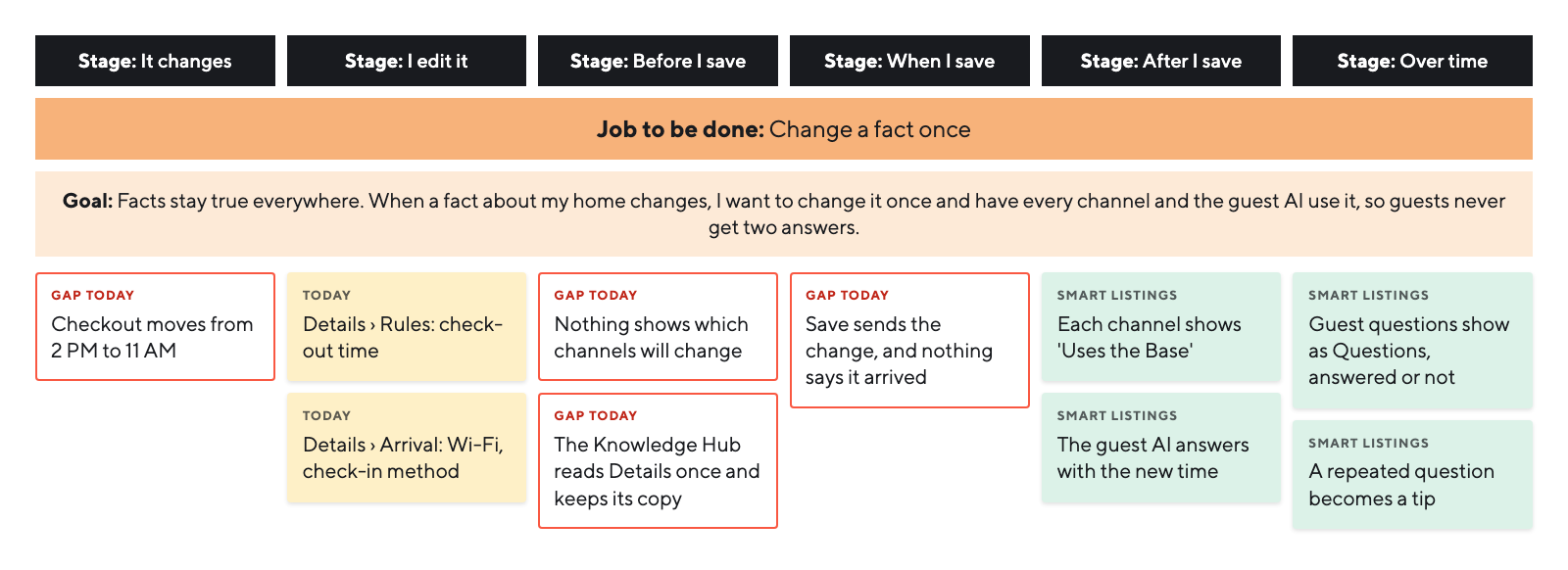
Its copy drifts, the AI answers from it, and guests’ questions go unseen.
Details
Amenities
Knowledge Hub
Is the apartment wheelchair accessible?
Yes, the apartment is wheelchair accessible!
On a trial listingSame facts, written twiceSource-of-truth claritySev 4
Edits to Details don’t reach it
Answers from the copy, not the listingAI transparencySev 4
SoEach fact lives once, in the Listing base. The Hub reads it and learns from guests’ questions.
The Hub copies the listing instead of reading it.
Details
Knowledge Hub
Hospitable’s help centreA trial listing
Recreated from a trial listingHospitable’s help centreSeverity 0 to 4, one evaluatorHow the Hub works today
DiscoveryHeuristic evaluation
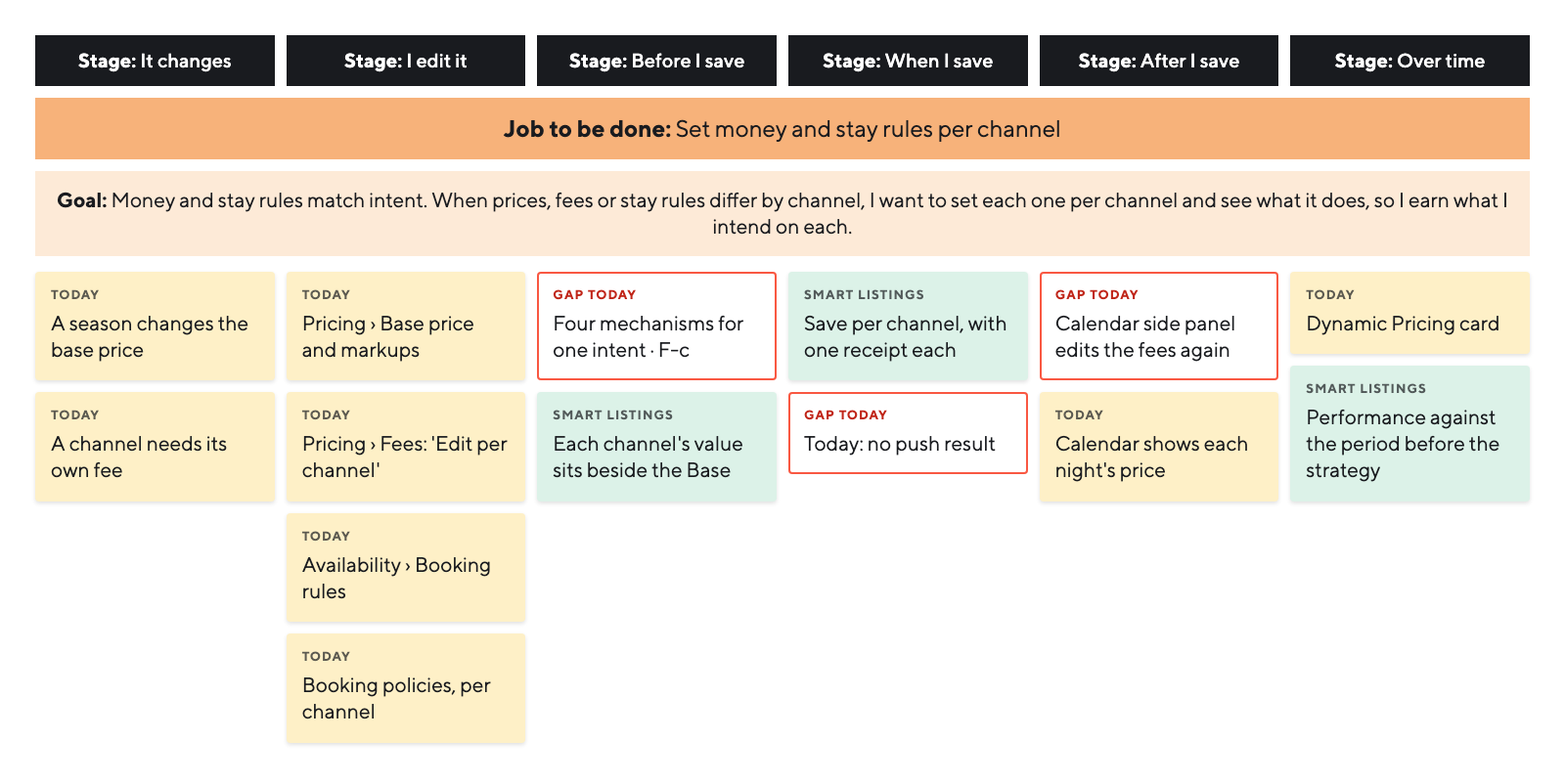
Hospitable keeps per-channel values field by field, never as one listing.
What does my Airbnb listing say?
~15fields
No page shows the answer
Per-channel awarenessSev 47 ways to say “different on each channel”Consistency and standardsSev 3
SoEach field saves on its own: a change reaches the channels that read it. A custom value stays on its channel.
Product auditSeverity 0 to 4, one evaluator
DiscoveryData analysis
Not run yet.
1Which fields do hosts override most, and is any text field among them?
2How often does a ticket say the assistant contradicted the listing?
3How many tickets ask where to edit something, and what do they cost to resolve?
4Does listing trouble rise with portfolio size in sales calls, and when does it become a reason not to buy?
5What do hosts ask for on the board without being asked?
SoIt sets what tips must cover.
618 calls, 457 accountsPulls not run, no Hospitable data yet
DiscoveryResearch questions & assumptions
The hypotheses behind a view per channel, scored by importance against evidence. Booking.com's own docs partly refuted one.
Refuted, then turned into a rule
Writing back to Booking.com was my number two bet. Booking.com writes its own description, so a host's voice there is the quality of their facts.
Test these first
Booking.com and Hospitable help pages
DiscoveryResearch plan
Ten methods over four weeks. Hosts can be simulated to show the method. What Hospitable's own teams know never is.
Get ready
Which assumptions would sink the design?
Kick-offAssumption mappingData accessRecruiting
Data and teams
What can Hospitable write on each channel, and how fast?
Sales calls (Gong)Ticket analysisField override usageKnowledge Hub usageStakeholder interviews
Hosts
When do hosts trust an AI tip? Where do they look for listing content?
User interviewsCard sorting
Synthesis
Which pains share a cause?
Cluster analysisAffinity mappingThe readout
None of their answers is simulated
Who I'd talk to
What do hosts need, what will the channels allow, and what structure does that add up to?
MethodsUser interviewsData analysisCard sortingTree testing
Outputs
Object modelNavigation optionsSitemap
Interview synthesisCard sorting resultsInsightsPersonasJobs to be doneProblem statement
ResearchMethod
I'd answer the question with 25 user interviews, a card sort and the data, and I already have public evidence.
1The question
Do hosts vary money and stay rules per channel, or only the words?
2Who I'd talk to
25
user interviews, including hosts who churned or never joined after a trial
15
hosts in a card sort
3What I'd check
618
sales calls in the brief
300
support tickets to tag, plus 100 untagged
4What I already have
115
reviews and posts
89
channel concepts
36
competitor products
5How an insight gets strongStrong means three sources of two kinds, one of them real
Interviews, card sort and ticketsSales callsPosts and reviews at trustpilot.com, channel docs and competitor help centres
ResearchPersonas
Hosts keep their truth where it's easiest: Airbnb, a doc, a sheet. Hospitable is only trusted when every channel matches it.
“You're the messages.”
PriyaNew to a PMS
One channel, fears reviews most
Time spent on listings, monthly
None, “that's the point”
“On Airbnb”
MartaFamily host
Varies only money per channel
Time spent on listings, monthly
About 1 hour
“My doc”
DanaSEO optimiser
Tunes titles, openings, photo order
Time spent on listings, monthly
6 to 8 hours
“The sheet”
CallumPortfolio manager
Compliance, markups, rate plans
Time spent on listings, monthly
About 20 team hours
The four host typesInterviews with four hosts, simulated; photos are Unsplash stock, illustrative
ResearchInterview synthesis
Nobody's real version is Hospitable's.
The AI speaks from a store no channel sees.
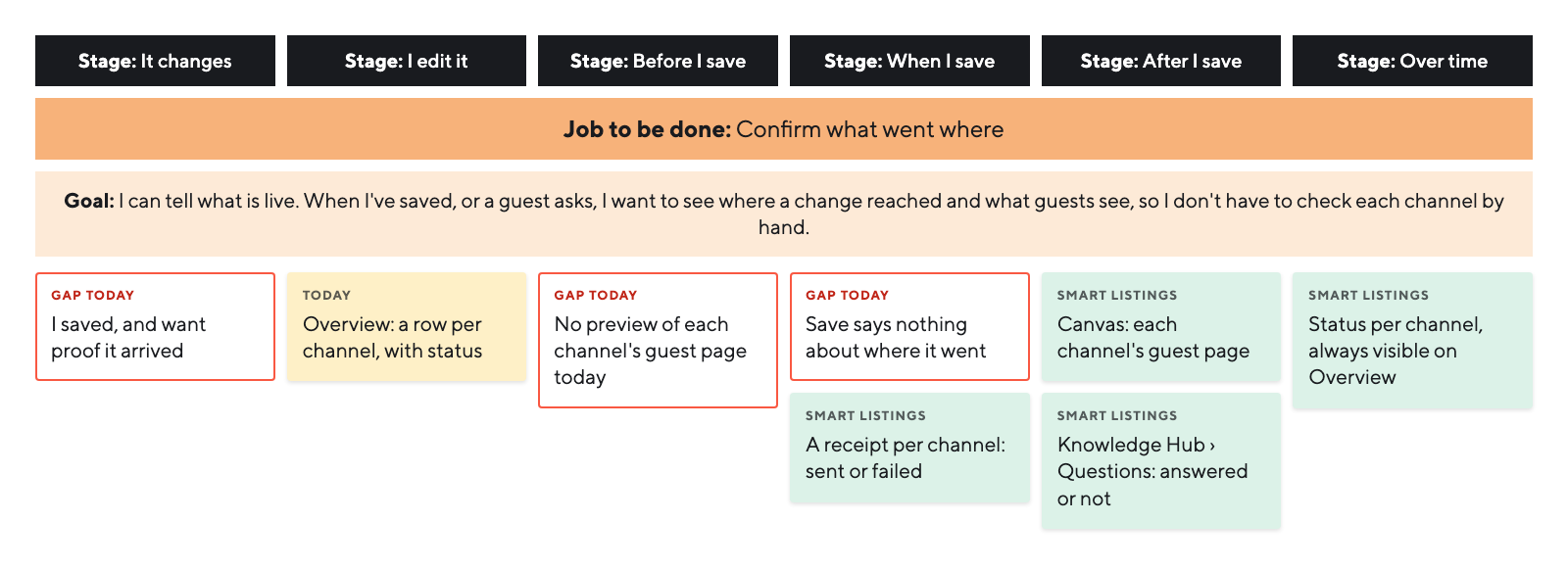
Saving says nothing about where it went.
They want to see a change before it's written.
A change shown as a field is hard to picture.
Money and stay rules differ per channel, not words.
Copy per channel is one persona's job.
On Booking.com, the voice is the facts.
SoA canvas. Each channel's real guest page, with the change on it, before save.
Five simulated interviews, grounded in public reviews
ResearchPain points
Hosts keep the truth elsewhere, can’t see changes, and distrust AI that sounds surer.
Product decisionOne Base holds each fact once, and every channel inherits it.
Product decisionMoney and stay rules can differ per channel. Copy stays shared.
Product decisionEach change shows its reach first, then a receipt confirms it.
Product decisionEach suggestion says why, where and how to undo it.
Sampled interviews and support dataHospitable’s public feedback board, where hosts ask for what they need
ResearchInsights
Six insights, by signal
51
Explaining raised trust, not checking
In simulated sessions the AI wrongly said the flat had a balcony. Explanations made people accept more, not check more. So invented facts must be blocked.
Per channel means money and stay rules, not words
Only the optimiser wants different words per channel: a channel's voice is a choice
They want to see a change before it's written, and proof after
The Knowledge Hub repeats the listing, and misses what guests ask
Synthesis of interviews and data, checked against the real product and public evidence
ResearchJobs to be done
Today's functions and gapsHelp CenterSmart Listings on sample data
ResearchCard sorting
Sort these cards into the groups that make sense to you, or make your own. A card sort tests how hosts think about their listing.
Cards to sort
Photos
Summary
Title, description
Getting insight and setup
Guest resources
House rules, Wi-Fi
Location
Address, neighbourhood
Amenities
Parking, safety
Booking policy
Cancellation, minimum stay
Pricing
Availability
Calendar
Shared across channels
In one channel
A group of your own
Name it, then drop the cards that fit it here.
Card sort, not run yetHospitable's property menu, my.hospitable.com
ResearchChannel constraints
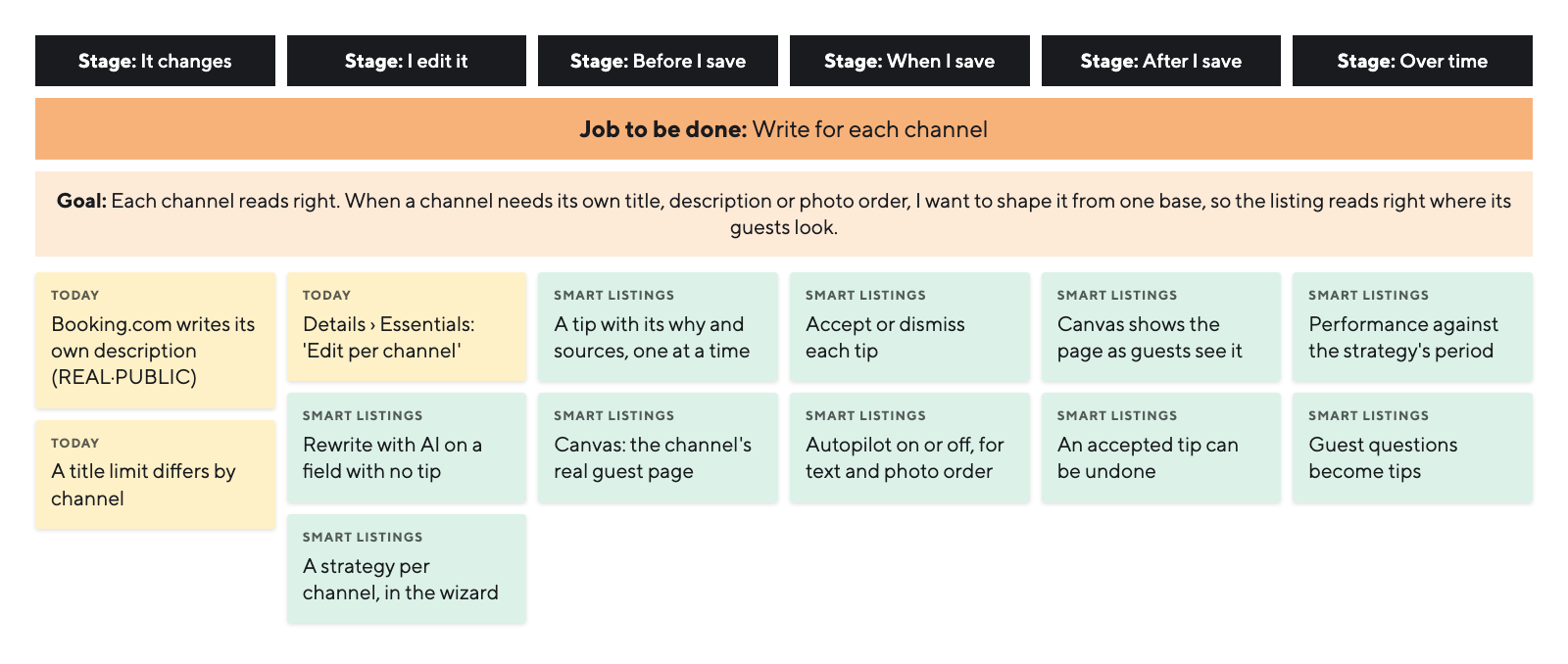
Booking.com writes its own description, so one editor can’t cover every channel. It is one example of a limit, and each channel has its own.
Airbnb
Hospitable writes it
An edit made on Airbnb forks the field
Booking.com
Booking.com writes it
From structured facts. Hosts can only request a fix
Vrbo
Hospitable writes it
Edits made on Vrbo are overwritten
Expedia
To be mapped
Its limits are part of the planned research
Direct
Hospitable owns it
No limits on title or description
| Channel | Title | Description |
|---|---|---|
| Airbnb | ≤ 50 characters | Sections, no published limit |
| Booking.com | 3 to 255 | Written by Booking.com |
| Vrbo | 20 to 40, banned words | One field, 400 to 10,000 characters |
| Expedia | To be mapped | To be mapped |
| Direct | No limit | Editable per channel |
The channels’ own documentation, for the rows that are filled in
Each channel’s limits, to be mapped in researchThe channels’ own documentation, Booking.com as one exampleThe limits
ResearchCompetitive analysis
Pricing tools check your rate against similar listings. The listing itself goes unchecked.
Comps for price, today
Generic recreation4 of 6market tools price by comps
Comps for the listing
Concept| You | Similar | |
|---|---|---|
| Title length | 31 | 46 |
| Photos | 14 | 27 |
| First photo | Bedroom | Living room |
| Amenities named | 4 | 9 |
| Description sections | 2 | 5 |
9 of 12 open on the living room.
2 of 36products point comps at the listing
SoAI comps for the listing, per channel, as Copilot tips.
Comps for price: PriceLabs and Beyond’s product pages, pricelabs.co and beyondpricing.comBoth panels are my recreations, with demo numbers
ResearchProblem statement
The problem
Hospitable keeps a home’s facts in two copies, varies the wrong things per channel, never says where a change went, and offers AI that persuades instead of being safe.
How might we…
Two copies
keep one record of the home that every channel and the guest AI read?
Wrong per channel
give money and stay rules one per-channel pattern, and make voice a choice?
Unseen changes
show each channel’s listing, and say where every change went?
Persuasive AI
let the AI write only what the record can back?
The Knowledge Hub repeats the listing in its own copy, and learns nothing from guests’ questions
"Per channel" is built field by field, for copy. Hosts vary money and stay rules
No screen shows one listing on one channel, and Save doesn’t say where a change went
The AI persuades instead of being safe by construction
Hospitable’s product, for causes 1 to 3The sampled research, for 2 and 4
The product auditMy synthesis of the sampled researchFour root causes
ResearchObject model
An object model is a product's nouns: what it's made of, and how they connect.
Property
The home. Every fact, once.
Listing
The home on one channel.
Sync direction
not yet established
Source
Where each fact came from.
Projection
One fact, worded for each channel.
Copy
What guests read: shared, or per channel.
Receipt
Proof a change reached the channel.
A fact comes from a Source, lives once on the Property, is projected to each channel, and becomes the Copy on a Listing. Every save returns a Receipt.
From the briefNew: 4 of 22, missing today
Exists today, in some formNew: Hospitable lacks it
A Property holds Facts. Each Fact remembers its Sources and reaches each Listing through a Projection, or an Override. Guests read the Base's Copy unless a Listing has its own, always grounded in Facts. Every change goes out with a Receipt.
Marked: the four new objects
On screen
The truth band
→Shared: the Listing base, which the Knowledge Hub reads
Each listing band
→A channel's own pages
Property, listing and the sync directionThe whole model
ResearchChannel constraints
A host shouldn't need four dictionaries to say they have a bath. Hospitable does the translating.
The host says it once
Bathtub
Hospitable translates it for every channel, as it already does for amenities
My canonical field map, from each channel's own documentation: Expedia's Product API for Expedia
The bathtub is one example. Same pattern forWasherBedsSmokingHouse rulesand every other fact
Today each field has two statesOne valueEdit per channel
Channel documentation, and Hospitable's help centre on amenities per channel
Airbnb, Booking.com, Vrbo and Expedia documentation · Hospitable's help centreWhat it forces
ResearchNavigation options
I drew five ways Smart Listings could fit the menu, and compared them on the same tasks.
1Mode switch
A switch swaps the whole menu
Focused workspace
Other sections vanish
2One listing hub
One hub, a channel selector inside
No second copy
Biggest migration
3Sub-nav section
Today’s menu, plus one group
Nothing moves
Two copies drift
4Channel-first
Shared, then each channel’s pages
Fewest clicks
Grows per channel
5Assistant drawer
A drawer on every page
No menu change
No room, no home
SoShared holds each fact once. Each channel’s pages are where it can differ.
Shared
Each fact once, for every channel
Channel-specific
Each channel’s own pages. They show the Base until you change it there.
Airbnb
ListingPricingAvailabilityBooking policies
Booking.com
ListingPricingAvailabilityBooking policies
Direct
ListingPricingAvailabilityBooking policies
The prototype’s property menu, chosen in design review
Before the five menus, I compared seven structures on paper. Two ideas carried over.
Record-first
Every fact once, grouped by kind
Became Shared
State-first
What needs you comes first
Became Needs you, on the Overview
Compared on a simulated card sort, not with hosts
Five menus drawn in Paper and reviewed on the frames, not tested with hostsThe menu
ResearchSitemap
Laying out the sitemap, I saw hosts need to know what each channel repeats from the Base.
What each channel takes from the Base
On every field
Summary
Summary
Record-first won my scoring. When Smart Listings needed a home, I drew five menus and chose channel-first: fewest clicks on my frames.
The first test I'd run
Tree-test it against today's menu and record-first, 30 hosts each. It passes within 5 points of record-first, and at 70% on channel tasks.
Its risk is copied facts, so I designed that out
My design reasoning, to be checked by the planned tree test
Counts: the listing fields of my prototype's sample flatThe trade-off
What are the radically different ways to solve it, and which one earns the build?
MethodsDivergent ideationPattern referencesWeighted scoringConcept testing
Outputs
Design principlesConcept directionsFinal concept
ConceptDesign principles
I let the research rewrite my draft. Three changed, one was added, and number three became the spine.
| My draft | After research | Why | Signal | |
|---|---|---|---|---|
| Nothing is lost | → | Nothing written unseen | A restore point answers the wrong moment | |
| None | → | Facts once New | Two stores of facts disagree | |
| Facts shared, voice local | → | Money and rules vary. Voice is a choice | Money and rules vary per channel, words rarely | |
| Show the why first | → | The AI says only what the home can back | A reason raises acceptance, not scrutiny |
The first, third and fourth lean most on the simulated interviews
1, 2 and 7 are floors every direction had to meet. 3 to 6 are where the directions differ.
Signalfor 1, 2 and 7for 3 and 5
From the simulated researchWhere each came from
ConceptDivergent ideationRound one
Each had its own primary object and first action, all drawn on the same flat. None won every screen, so I kept two that cover each other.
Channel Canvas
“Check my shop window”
What will guests see?
Golden Record
“A master spreadsheet”
Copilot
“Tell someone what you want”
Decision Inbox
“Only show me what needs me”
What needs me?
Merge & Versions
“Drafts and versions”
Fact Blocks
“A house manual I write once”
Home Tour
“Walk me through your flat”
Channel Canvas
Golden Record
Copilot
Decision Inbox
Merge & Versions
Fact Blocks
Home Tour
Knowledge Hub
Listing studio
Portfolio
No direction won every listing screen. The Canvas won the studio and the Inbox the portfolio, so I took them as a pair.
A simulated scoring of the seven directions, my design judgement before any concept test, not host evidence
Scores are my design judgement, made before any concept testFrames and scores
ConceptPattern referencesRound two
I ran the same Smart Listing flow through twelve patterns people already trust. Two became the core of the build, and four lent it a part.
In the buildA part of it
Listing score
Google Ads · Yoast
Live canvas
Squarespace · Notion
Copilot on every screen
Shopify Sidekick · Notion
Channel composer
Buffer · Hootsuite
What-if simulator
Credit Karma · PriceLabs
Strategy picker
Grammarly · Spotify
Goals and guardrails
Performance Max · Advantage+
Suggesting mode
Notion · Linear
Readiness guide
Squarespace · Vanta
You vs similar homes
Hootsuite · Tripadvisor
Rate calendar first
Turo · KAYAK
Guided pass
Zoho CRM · Navattic
Every direction ran the same eight steps under the same rules, so only the pattern changed.
Pattern references from the vendors’ own pages and saved screensSame flow
ConceptFinal concept
Round one set the shape. Round two gave the model. A strategy per channel turns into tips with their why, seen on the channel’s real page.
Round one
Round two
In Smart Listings
A strategy per channel
Who it’s for, a goal, guardrails
Tips with their why
One at a time, with sources
The Canvas view
Each channel’s real page
Rewrite with AI
Any field without a tip, even with Smart Listings off
43 comments on the live canvas
set the model: switched on per property, a strategy per channel, one tip container, Classic and Canvas, Performance
Four steps were too many
so the strategy became a short wizard, one question per screen, on Hospitable’s own pattern
“Do it on the real thing”
so the model left Paper for the coded prototype, with the channel-first menu
How it converged
Smart Listings, built in code on Hospitable’s own UI, and pruned in every review.
MethodsPrototyping in codeDesign reviewsResponsive designAccessibility review
Outputs
Solution overviewUser flowsTips & AI rewriteCanvas previewDesign systemMobile & tablet
DesignSolution overview
Facts live once, channels keep only what differs, and you decide what the AI does alone.
Creates Airbnb’s own value. The Base stays as it is.
Shared: every fact once
Channels: one page set each
Every field shows its source
A tip, with its why
Every fact lives once, in Shared, and each channel holds only what differs. A strategy per channel produces tips, each with its why. The host accepts or dismisses them, unless Autopilot is on for words and photos.
The prototype as built, demo data
I reviewed the running build, and each review took something out.
Versions
A concept to learn before any payoff.
One current strategy
Compare mode
One baseline already answers “did it work?”
The weeks before, in grey
Setup page
It looked just like Strategy.
One full-screen wizard
Canvas editing
A second editor for the same field.
A tap opens the field
Autonomy dial
Three levels per content type. One switch is simpler.
Autopilot, on or off
Tips and reasons, demo dataThe map, and what I cut
DesignListing base
Every channel and the Knowledge Hub read the same listing detail. So the Listing base holds only what channels share, and each field shows its reach.
Listing base · Arrival
Check-in time
Kept once, here.
Read byAirbnbBooking.comDirectKnowledge Hub
Source of truth
Its reach, under every field: never a surprise
Product audit: the check-in time from a trial listingThe prototype, on demo data
DesignKnowledge HubConcept
A concept, not built in full: guests’ questions reveal gaps, and each gap becomes a tip for the Base or one channel.
Inbox
Is there free parking?
Knowledge Hub
Listing base
Guest AI
1A guest asks in the Inbox
2Counted, answered or not
3A gap becomes a tip
4The host’s answer becomes a fact
5Every channel and the AI use it
A concept, not built in full: how the Hub can feed the tips. A gap becomes a shared fact for the Listing base, or a better answer in one channel’s listing, such as Airbnb’s description. Concept, demo data
Product audit: guest questions stay in the Inbox todayA concept: the questions and counts are demo dataThe flow
DesignChannels
The Base is where a channel starts, not where it stops. On every field, the host sets how much each channel takes from it.
Follows the Base
The same on every channel.
Airbnb · Listing
Other details to note
Customized for Airbnb
Its own words, for Airbnb search.
Airbnb · Listing
Summary
Only on Airbnb
No other channel asks for it.
Airbnb · Listing
Check-in method
Booking.com
Booking.com writes its own description. So on its page the field is read-only, a lock replaces the ⓘ, and the lock says why.
Booking.com · Listing
Description
The prototype as built, demo data
Every field is one of four cases. “Use the Base” keeps the custom text, so “Customize” brings it back.
Walked in the prototype, demo data
The prototype’s demo flat, as builtSet by the channel
DesignStrategy
Opt-in per property, since not every host wants AI. It reuses Hospitable’s Add-property wizard. Each suggestion says why.
Goal
Who it’s for
Guardrails
Autopilot, off by default
Airbnb · Strategy 1 of 3
Smart Listings never goes outside them.
Keep my nightly price between
Prices and fees, Minimum stay and rules, Cancellation policy · Always asks you. This can’t be turned off.
Opt-in per property, because not every host wants it, and turning it off keeps everything. The wizard copies Hospitable’s Add-property flow, which hosts already know. Closing it halfway changes nothing. Walked in the prototype, demo data
Pattern: Hospitable’s Add-property wizardSuggestion evidence, demo dataThe three strategies
DesignTips & AI rewrite
A suggestion without a reason is a guess. Each tip sits beside its field, with its sources.
…by the window with an ergonomic chair and chair, a 27" monitor, monitor and 250 Mbps fibre Wi-Fi (tested on 12 Sep), plus the paintings, a sofa and…
Each field shows one AI marker at most: its tip, or Rewrite with AI where you can type right now.
Purple: the AI suggestsOrange: you ask
Both use the same card, so hosts learn the AI once. Rewrite with AI works with Smart Listings off too.
Tips cover prices and stay rules too, where hosts differ most per channel. On a shared field, the tip says so.
Applies to every channel
One panel and one tip at a time keep the decision next to the field it changes, with its reason in view. With Autopilot off, nothing changes until the host accepts, and Undo withdraws the change it sent. Walked in the prototype, demo data
Tip content and reasons, demo dataOne AI per field, and prices tooThe flow
DesignCanvas preview
Hospitable publishes with no preview today. I rebuilt each channel’s real guest page. A tap opens the field behind it, its tip or Rewrite with AI.
Classic or Canvas, one switch
Changes publish without a preview
DesignPerformance · concept
A concept: since the strategy started, against the same weeks before.
Airbnb occupancy
+20points
60% since 14 Aug, 40% before
Airbnb revenue
+39.2%
€1,507 since 14 Aug
7 weeks before 40%Since 14 Aug 60%+20 points
25 Jun14 Aug25 Sep
Next ideaStrategy versions on Airbnb
Version 1Since 14 Aug · +20 points
vsVersion 2From the next change
Not designed in full: where Performance would compare one strategy with another.
Occupancy on Airbnb, by version
Version 1
Since 14 Aug, 7 weeks
Before
40%
Since
60%
+20 pointsVersion 2
From the next change
Compared with
Version 1
Since
Not started
ConceptVersion 1: Performance demo dataVersion 2: a concept, not designed in full
Performance, demo dataCards and bars follow Hospitable MetricsStrategy versions
DesignAutopilot
With Autopilot on, text and photo-order tips apply inside the host’s guardrails, since they are cheap to undo. Prices, stay rules and cancellation always wait for a yes.
May apply on its own
Always asks you first
Locked: it can’t be turned off
The editor says Autopilot is on
Should Autopilot apply tips for you?
Off is the default. Tips wait for the host, and nothing changes until they accept one.
Switch it any time
The Autopilot question
DesignMobile & tablet
To make that possible, I built an app mode that runs every screen as Hospitable’s mobile app: sheets, swipe-back, tips in a bottom sheet.
Built in part, under the case’s time limit. Many improvements are still needed
DesignPresets
The four hosts in my research want different amounts of help, not different products. So I designed presets, not personas: defaults change, capability never does.
| Host | Preset |
|---|---|
| P1 Family host | One home · Standard guidance, Smart Listings off |
| P2 SEO optimiser | Few homes · Expert detail, Smart Listings on |
| P3 Portfolio manager | Portfolio · Standard guidance, Smart Listings on |
| P4 New to a PMS | One home · Guided, Smart Listings off |
“We don’t label you”
Personas from the simulated research
DesignDesign system
They change how every part of Hospitable is organised, not only listings.
Drill-down navigationOnly the main menu had it. Now every section does.
Counts that moveThe total on the parent when closed, each page’s own when open.
Property name
Guests see it in search.
Stacked fieldsLabel above the input, so Tips or Canvas fit beside it.
Also: Save changes only when something changed, and one outlined ×.
Built on Hospitable’s own components, as in the prototype
DesignDesign system
Before they spread, I’d weigh them with each team, then test.
Tip card
Tips drawer, markers
Rewrite with AI
Channel badges, reach caption
Canvas preview
Save toast, Undo
Section tabs with tip counts
Reaches
Evaluate, then test
My reading of where each pattern would land, to check with each product team. Raspberry names: patterns I challenged
Not run. Each test sets the alternatives side by side before anything spreads
Built on Hospitable’s own tokens and componentsThe areas they reach are my reading, to checkThe impact
Do hosts understand it and trust it? And how would I know it works?
MethodsBenchmark testUsability testingA/B testing
Outputs
Test planGoals & KPIsPre-mortem
TestingTest plan
Nothing is tested with real hosts yet. Six steps follow, each with a bar set before it runs.
Same tasks at every step, so results compare. Accessibility gates each one.
Where facts live
Where does this fact live? What happens on Airbnb if you change it here?
The Base
If you change the Base cleaning fee now, what happens on Booking.com?
Why this tip
Why was this suggested? Which channel does it change?
Autopilot
Would you let it apply this kind of change by itself? Which kinds never?
My test plan: every bar is written before its step runsThe probes and the bars
TestingGoals & KPIs
The goals I set at the start, each with its KPI and test.
North star
Time to adjust ≤ 60today = 100
Benchmark, A/B
Trust check
Satisfied ≥ 80%
KPI
Bet
Test
+7%
Bookings per listing
H-10Channel copy sells
Rollout vs holdout
25%
Properties with a strategy
H-04A voice per channel
Pilot, per segment
50%
Adopters acting monthly
H-09Trust in AI tips
Pilot, six weeks
40%
Acceptance rate
H-09Trust in AI tips
Usability rounds
−10%
Tickets per 100 properties
H-15What Autopilot may touch
Rollout vs holdout
North star · Benchmark, then A/B
Time to adjust ≤ 60
1H-09 · Trust in AI tips
Usability, then pilot
2H-04 · A voice per channel
Pilot, by host type
3H-15 · What Autopilot may touch
Pilot, then rollout
H-10 · Copy per channel sells
Rollout vs holdout
Guardrails
No unsupported AI claims
Wrong-channel edits ≤ 10%
Rejections ≤ 2%, never silent
Targets at 90 days, set before any data. The pilot sets the real onesBets ranked by importance against evidence
What went wrongEarly signalWhat I’d do
Ordered by how much each would hurt. Every threshold is written before any data
Targets at 90 days, set before any data. The pilot sets the real onesThe bets, from my assumptions mapThe KPI treeHow it could fail
How would I tell it, what else does it change, and what comes after it?
MethodsSystems mappingRoadmappingPilotStaged rollout
Outputs
Second-order effectsRoadmapWhere it falls shortSmart Listings across Hospitable
Next stepsStory and product
1What I’d tell hosts
On Airbnb
DescriptionUses the Base
SummaryCustom for Airbnb
Check-in methodAirbnb only
Property name updatedApplied
Weekly discountAsks you
2Where I’d take the product
Mapped next
AI Copilot: hospitable.comThe product direction is a plan
Next stepsService map
Facts kept once and one kind of tip can reach every part of Hospitable.
BuiltNextLaterImplied, not built
Shared
Built
Next
Later
tips · the Base results the Base answers price, positioning tips periods facts, once questions tips receipts goals answers, insightsNow
Sample figures behind tips and Performance
Questions and insights: a concept
Missing
How
Define “similar” with Data. Aggregates, never another host’s text
Count Inbox questions. Answer only from the Base. Gaps become tips
With
Worked if
Tips citing similar homes accepted, not reverted
Fewer questions left open
One tip contract, for any area
Calendar
Inbox
How
The design system owns the contract. Calendar and Inbox first, then each area adds its tip types
With
Worked if
Accepted out of shown, per area. Undo ≤ 5%
One channel, week by week
Weekly occupancy on Airbnb. Each strategy is its own period, compared with the weeks before it and with similar homes.
Before
Strategy 1
Strategy 2
Too soon
Similar homes
Tip applied
Built
One channel against the same days before. Eight cards, four charts
Missing
Measure
Show
Periods as bands, applied tips as dots, similar homes as the season
A sketch with made-up weeks, to show the idea, not data
MetricIt saysIt opens
How
Events and a fair minimum period, agreed with Data. Then Copilot answers and opens the tip
With
Worked if
Half of adopters act on a tip each month
Test programmeHosts
Per-field confirmationIntegrations
AI checked offlineAI and ML
Performance eventsData
Real hosts first
Import and setupSame Base
Similar homesImplied
Performance over timeImplied
A deeper Knowledge HubImplied
North star: confirmed live in 7 days
Sequential testsMeasured
Copilot widensWhere it helps
Tips everywhereOne contract
Typed factsAPI
After the tests
Patterns that travel
FactSourceInheritanceTipReceiptAutonomySharedCheck-in time
Airbnb
Booking.com
Direct
Guest replies
Operations
One wrong fact now reaches every channel and every guest reply, so every fact shows its source and its reach.
If a channel bans automated edits, Copilot stops applying tips there. Tips still show
Hard for others to copy, but it uses other hosts’ data. Legal reviews it first
Fewer “where do I edit?” tickets, more “why did Copilot change this?”
Effects I expect. None observed, because nothing has shipped
If this happensThresholdWhat I’d do
Thresholds set before any result
Built: in the prototype, on sample data. Next and later: my plan, nothing measured.Where it falls shortPerformanceRoadmapWhat it sets off
Close
Four things, one week. Every team gets its questions in writing. Friday’s readout decides what changes.
2Kick-off. Questions out
2Owners and roadmap
4Data access
1Benchmark set up
2What each channel accepts
2What feeds the Hub
2Overrides, signals
4400 tickets
1Recruiting with Marketing
360 calls coded
4Usage exports
1Benchmark: 40 unmoderated, 5 moderated
4Tickets, edits read
2What needs a person
2AI copy, channel terms
1Round 1 booked: 8 hosts
My plan, not run. Sizes from the research plan and the test plan
hospitable